
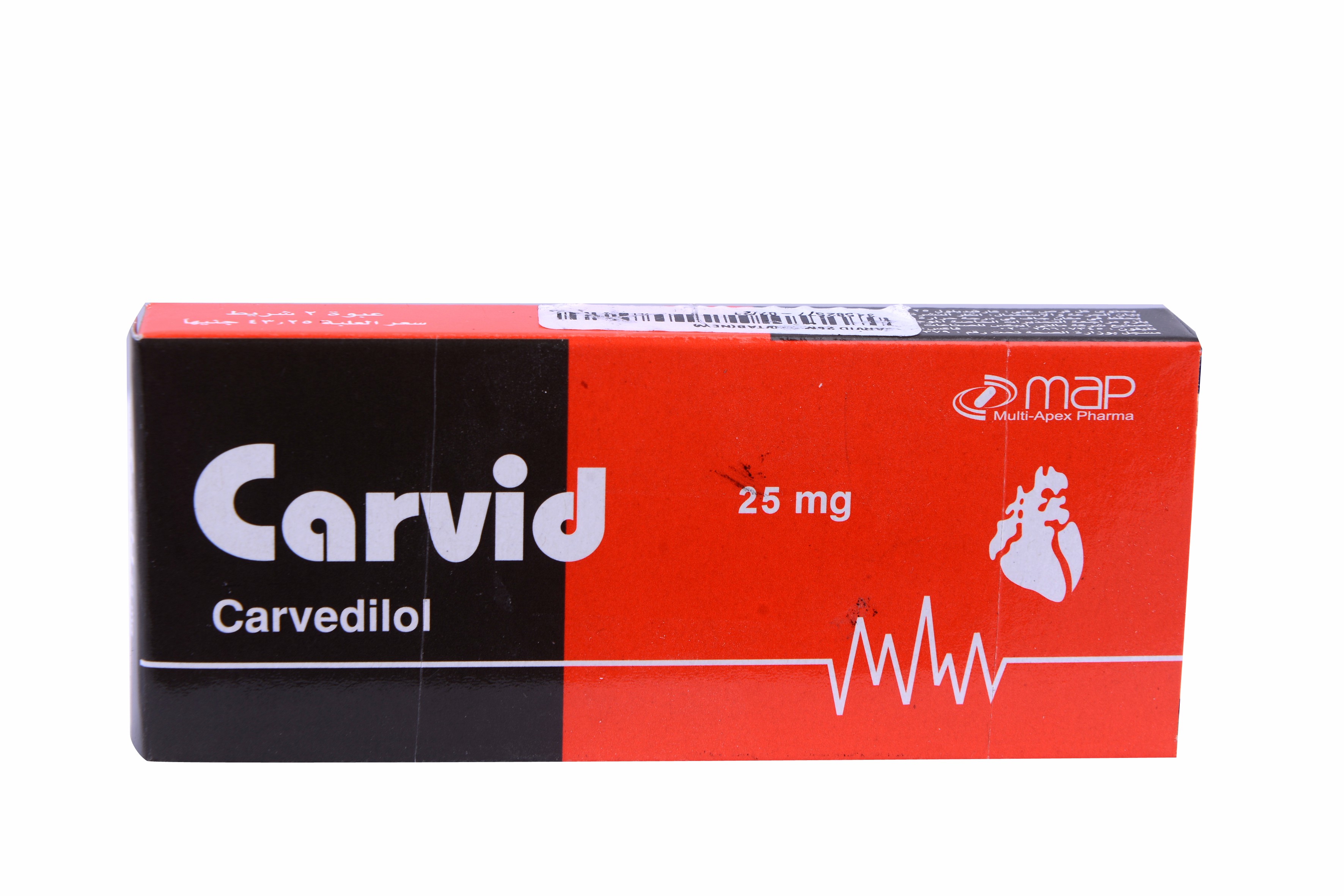
Carvid
Carvid 25mg 20 Tablets
E£ 81,00
Quantity
1
Free delivery over 300 EGP · 24hr express in Cairo
100% authentic — licensed Egyptian pharmacy
14-day return on unopened items
Active Ingredient: Carvedilol Hypertension: Management of hypertension.
The 2014 guideline for the management of high blood pressure in adults (Eighth Joint National Committee [JNC 8]) recommends initiation of pharmacologic treatment to lower blood pressure for the following patients (JNC 8 [James, 2013]):
• Patients ≥60 years of age, with systolic blood pressure (SBP) ≥150 mm Hg or diastolic blood pressure (DBP) ≥90 mm Hg. Goal of therapy is SBP <150 mm Hg and DBP <90 mm Hg.
• Patients <60 years of age, with SBP ≥140 mm Hg or DBP ≥90 mm Hg. Goal of therapy is SBP <140 mm Hg and DBP <90 mm Hg.
• Patients ≥18 years of age with diabetes, with SBP ≥140 mm Hg or DBP ≥90 mm Hg. Goal of therapy is SBP <140 mm Hg and DBP <90 mm Hg.
• Patients ≥18 years of age with chronic kidney disease (CKD), with SBP ≥140 mm Hg or DBP ≥90 mm Hg. Goal of therapy is SBP <140 mm Hg and DBP <90 mm Hg.
In patients with CKD, regardless of race or diabetes status, the use of an ACE inhibitor (ACEI) or angiotensin receptor blocker (ARB) as initial therapy is recommended to improve kidney outcomes. In the general non-black population (without CKD) including those with diabetes, initial antihypertensive treatment should consist of a thiazide-type diuretic, calcium channel blocker, ACEI, or ARB. In the general black population (without CKD) including those with diabetes, initial antihypertensive treatment should consist of a thiazide-type diuretic or a calcium channel blocker instead of an ACEI or ARB.
Heart failure: Mild to severe chronic heart failure of ischemic or cardiomyopathic origin (usually in addition to standard therapy [eg, diuretics, ACE inhibitors]).
The ACCF/AHA 2013 heart failure guidelines recommend the use of 1 of the 3 beta blockers (ie, bisoprolol, carvedilol, or extended-release metoprolol succinate) for all patients with recent or remote history of MI or ACS and reduced ejection fraction (rEF) to reduce mortality, for all patients with rEF to prevent symptomatic HF (even if no history of MI), and for all patients with current or prior symptoms of HF with reduced ejection fraction (HFrEF), unless contraindicated, to reduce morbidity and mortality (Yancy, 2013).
Left ventricular dysfunction following myocardial infarction (MI): Left ventricular dysfunction following MI (clinically stable with LVEF ≤40%)
BUNDLE & SAVE
Frequently bought together
PAIRS WELL WITH
Complete the routine
YOU MAY ALSO LIKE
Related products
CONTINUE BROWSING